
 Posts
Posts


Well, I only say this because of a personal experience that has got me thinking for the past 16 years. I've based my opinion on the fact that my family has a long history of diabetics. In my family tree, only the MALES get diabetes through inheritance. Although I don't have it yet, there is a chance that I may. And yes, it scares me.
But I digress. What does this have to do with my opinion? Well think about it. If we could select what traits children can have, we might be able to eliminate diseases and disabilities. Why stop at diseases? These babies can be physically perfect! Designing babies can include choosing sex, eye colour, and hair colour to name a few. Now go beyond the superficial. When designing a baby, we may be able to select genes that affect IQ and personality. Wouldn't you want a smart and popular kid?

This picture is too cute :)
Let's take it a step further! I'm sure as a kid, we've all wanted to be like our favourite superhero we see on the TV. With science ANYTHING is possible! Scientists are currently doing research on artificial and animal genes. If a human can harbour these special genes, think of the possibilities of a generation of super humans. I've always wanted to have the strength of a lion or the voice of a songbird. I'm sure girls would want to have the grace of a swan or...something else I can't think of at the moment. haha.
I'll go a little more in depth with my points. My first one was about diseases. Imagine a world without a single disease going around. Imagine us having all the genes that carry immunities to those diseases. Wouldn't that be awesome? For example, by selecting genes we do not want we can remove a hereditary disease known as CYSTIC FIBROSIS, an autosomal recessive gene. This disease causes progressive disability and early death. Other genetic related diseases are Huntington's disease and muscular dystrophy. All these diseases can be isolated when we design a baby.
 A woman with Huntington's is confined to a wheelchair.
POINT DEUX: cosmetics. When we hear that word, we think of appearance. Let's face it (no pun intended): we are all about the looks no matter what age we are. We all wish to be hot and sexy. Well, we can have that if the right genes are placed. Also, we can achieve physical perfection if the wrong genes are isolated. We can isolate the gene for acne. I'm pretty sure that teens everywhere would want that. Who knows, there's probably a gene for fitness. Guys want abs and girls want curves.

AHHH! The horror!

 Isn't this what we all want? (Don't deny it)
Numero three: mental condition. If we select the genes that make kids significantly smart, wouldn't that be a better future for everyone? Imagine IQ's reaching, like what, six digits! WHOA! Fantasize about the possibilities: technological advancements, job opportunities, medical discoveries, the list goes on. Basically, a better world.
And look at personality. Selecting what kind of personality our children would have opens many doors for them. If they have a funny personality, they have a career as a comedian. If they have a persuasive personality, they would succeed in the business world. I could go on about this...but I won't. I'll just leave the future to your imaginations.

Popularity plays a big role in child development.
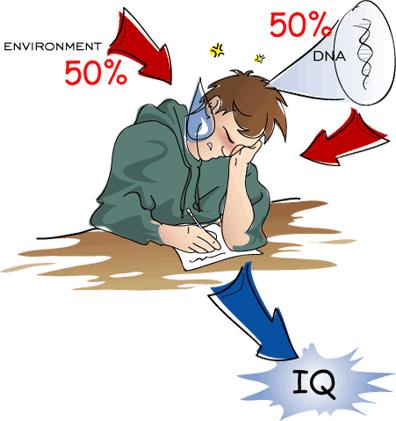
Our overall IQ is affected by environment and genetics.
Finally, SUPAH POWAS!! Haha, only kidding. But you get my point. Scientific research has lead us to integrating animal and human genes with each other to create a new hybrid creation. We can select genes that make us fast like a cheetah, strong like a rhino, wise like an eagle, etc. If only we can get the genes that make us fly :P But honestly, if we did have a new generation of humans think of how it could affect our world. If we were as fast as a cheetah, we wouldn't need so many cars on the road to get to our destinations. If we were as strong as rhinos, we would not need expensive machinery for construction. Sure this all sounds out of this world, but this can be possible.
Oh yeah, that wasn't exactly the final point. I came across some last minute reading and I thought that it should be mentioned. When we design a baby, we can copy it's exact genetic makeup to make a twin. If ever the original has health complications, then the twin can be used for organ donations and other resources like blood transfusion.
Okay, so I've basically said what is so awesome about designer babies. Here's a few counterarguments to consider though. But trust me, the good outweighs the bad in this case.
The first bad thing about designing a baby is that there is a price to pay...literally. This stuff's EXPENSIVE! I am not exactly sure what the price is but there is no hope of it being cheap. It's a scientific breakthrough so start saving up if you want a beautiful child.
This second point might not be so harsh on the wallets but it may take a toll on love lives. In order to design a baby, the sperm must enter the egg via in vitro fertilization. That means no doing the "freak nasty" for all you couples out there. What's the fun of having a baby if you don't get to make it?
The last point is a moral violation. Referring to the "twin" example before, designing a baby makes it feel used. It is a sort of "organ factory" for the original and not to be used for his/her own needs. Another violation would be that the "perfect" humans would look down on the normal humans as being inferior. Presently, there is discrimination against people like the blind or paraplegic.
SO THERE'S YOUR FACTS!!! A 5-3 good to bad ratio isn't that bad. But still, even though there are more good facts than bad, let us not forget what we get ourselves into when we design a baby. Think of both the rewards and the consequences.
Take it easy, my scientific brethren.
RESOURCES:
http://www.bionetonline.org/English/content/db_eth.htm
http://www.bionetonline.org/English/content/db_cont1.htm
http://www.bionetonline.org/English/content/db_cont2.htm
http://www.bionetonline.org/English/content/db_cont3.htm
http://en.wikipedia.org/wiki/Cystic_fibrosis


